


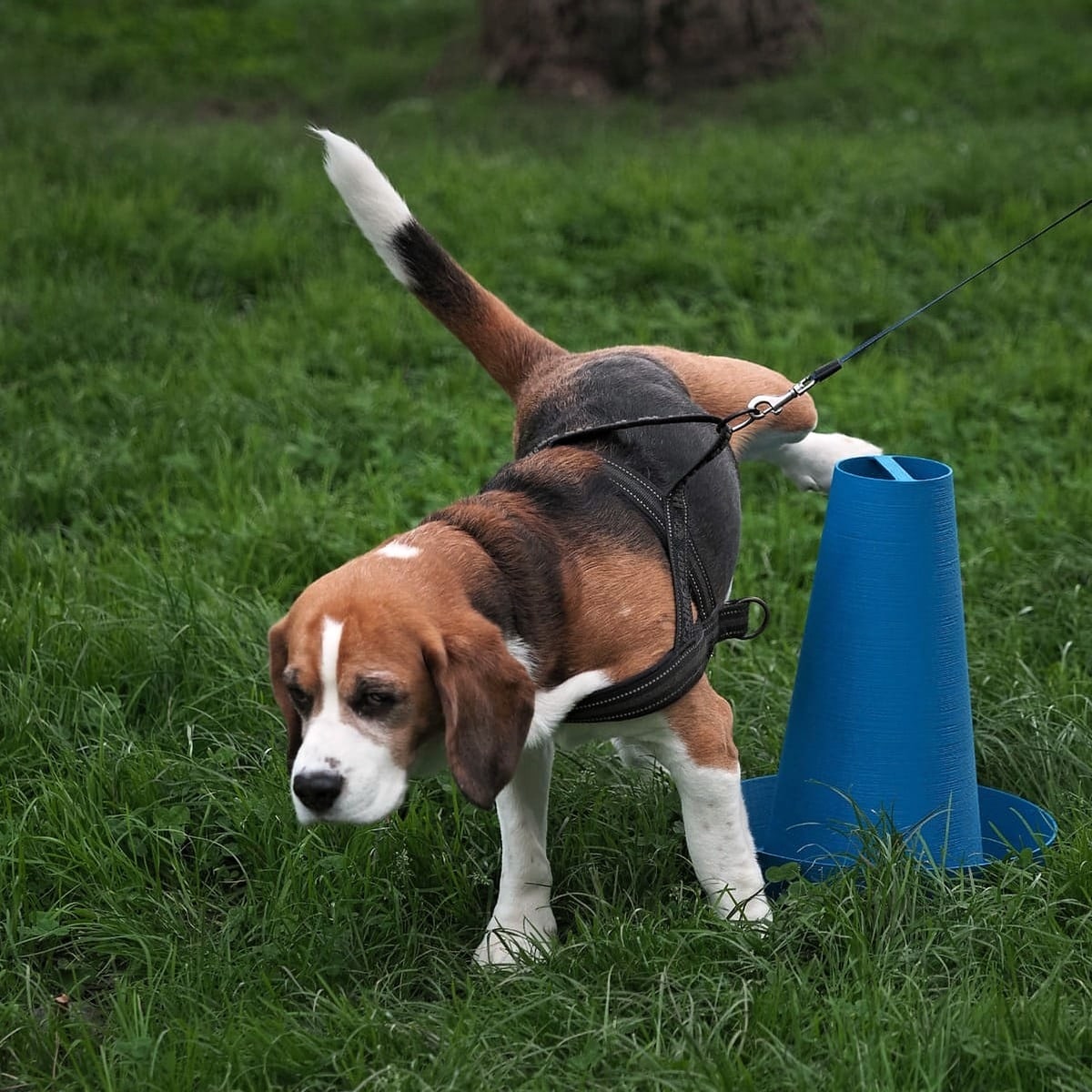
At what age a male puppy lifts his leg (and what changes at home)
One day your puppy stops squatting and aims upwards. It is growing up, not a problem: but the toilet corner at home needs updating.
In this guide
Why, at some point, he lifts his leg
Lifting his leg is how a male leaves his message high up, “at nose height” for other dogs: the American Kennel Club describes it. As a puppy he squats like everyone else; as he grows, many males switch to aiming upwards. It is part of growing up, like losing baby teeth: you do not teach it and you cannot stop it.
And every dog is different: some start early, some much later, some switch between the two positions for life. If yours keeps squatting, there is nothing wrong with him: it is not a fault to correct.
What changes at home, in practice
The geometry changes. As long as he squats, the training pad catches everything. On the day he aims upwards, the stream goes on the wall, the furniture or the edge of the tray: the pad still does its job on the floor, but the upper level is missing. Hence the protected skirting boards and covered corners that anyone with a young male knows well.
The answer is not telling him off (he is not doing anything wrong: he is growing up), nor putting more and more pads on the wall. It is giving his instinct a target made for it: a PIPPI vertical toilet in the corner he already uses, with the pad staying underneath as a safety net. If the wall problem has already started, the guide to setting up the toilet corner is the next step.
The right time to get him used to it
The switch to aiming upwards is also the most natural time to set up a fixed spot: your puppy is already changing his habits, and it is the easiest moment to give him a new one. The steps are those of the PIPPI Method: first you watch how he lives in the house and choose the spot, you leave him room to walk around the cone, and you reward him when he uses it. With a young dog, consistency helps, but with no promised deadlines: real timings vary from dog to dog.
One last thing: if your puppy pees little and often, or never seems able to hold it, he needs the vet before the target. Learning can only be built on a dog who is well.
The right spot, from when he lifts his leg:
Written by
The PIPPI team: a small Italian company, the same one that answers on WhatsApp. These guides go with the Method: no promises and no diagnoses (those are for the vet).